 9MLlqfipUnxl

Online parenting programmes are attracting growing attention because they can reach families who may struggle to attend in-person support. A systematic review published on 16 November 2026 in Child & Youth Care Forum examines the emerging evidence on online preventive parenting interventions and children’s outcomes, adding to a wider discussion about how families can access practical support.
The review, by Yubo Xu and Timothy Piehler, considers digital programmes designed to help parents before difficulties become more serious. Its focus is important because families often face barriers such as limited time, travel costs, childcare responsibilities, service shortages or uncertainty about where to seek help.
Why online support is being studied
Parenting support can take many forms: group sessions, individual coaching, home visits, community programmes and structured learning materials. Online formats may offer another route, allowing parents to access information or guided activities from home and sometimes at a time that fits around work and family routines.
Digital delivery can be particularly useful when specialist services are far away or when families prefer a more private first step. It may also make it easier to revisit information, practise a strategy and share selected resources with another caregiver.
But convenience alone does not prove that an online programme is effective. Researchers need to understand whether families use the programmes, whether the content is appropriate for different ages and circumstances, and whether any improvements last beyond the period of participation.
What the review contributes
The review brings together research on online preventive parenting interventions and child outcomes. Preventive programmes aim to strengthen family relationships and parenting skills before a concern escalates. Depending on the programme, support may cover positive communication, consistent routines, emotional coaching, behaviour guidance or ways to respond to common developmental challenges.
Systematic reviews are useful because a single study can be affected by its sample, setting or design. By examining a body of research, reviewers can identify recurring patterns, differences between programmes and areas where evidence remains limited. The review’s publication signals that online parenting support is an active research area, but it should not be interpreted as proof that every digital programme works equally well.
Families should also remember that a digital course is not a substitute for individualized professional care when a child has significant developmental, behavioural or mental-health needs. Online resources can complement support, but parents may still need advice from qualified health, education or family-service professionals.
Access is only one part of inclusion
For online parenting support to be useful, families need more than a website or an app. Reliable internet access, a suitable device, accessible language, privacy protections and content that reflects different family structures all matter. Programmes that assume every household has uninterrupted connectivity or high digital confidence may leave out the people they intend to help.
Language is especially important. Parents are more likely to use guidance when it is clear, culturally relevant and practical. Examples should reflect different living arrangements, work schedules and community contexts. Where possible, programmes should be tested with the families they are designed to serve rather than simply transferred from one setting to another.
Human support can also make a difference. Some parents may benefit from a facilitator who can answer questions, help them adapt an idea to their child’s age or connect them with local services. A blended model—digital resources combined with optional professional or peer support—may be more flexible than a one-size-fits-all approach.
Practical ways parents can use guidance
Parents exploring online resources can start by checking who developed the programme, whether its advice is evidence-informed, how personal information is handled and whether it clearly explains when to seek additional help. It is sensible to choose one manageable strategy at a time rather than trying to change every family routine at once.
Small actions can create opportunities for connection: listening without immediately correcting, reading together, naming emotions, keeping predictable routines and noticing a child’s effort. These practices are not a replacement for specialist support, but they can help make everyday interactions more supportive.
What researchers and service providers should examine next
Further research needs to look beyond whether parents sign up. It should assess who completes programmes, which families are under-represented, how children’s outcomes are measured and whether improvements continue over time. Studies should also compare different delivery formats and consider how online support works alongside schools, health services and community organizations.
For policymakers, the opportunity is to expand access without weakening quality. Clear standards, privacy safeguards, accessible design and links to local services can help online programmes become a useful part of a wider family-support system.
The new review adds to the evidence base, while also underlining the need for careful evaluation. Digital parenting support may make guidance easier to reach, but its value ultimately depends on whether it meets families’ real needs and helps create healthier, more responsive relationships at home.
Source
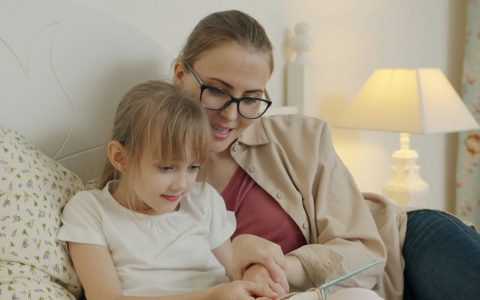
Image: A parent reading with a child. Photo by Vitaly Gariev / Unsplash.